

What Happened To The 3828 Men That Cleaned The Roof At Chernoable
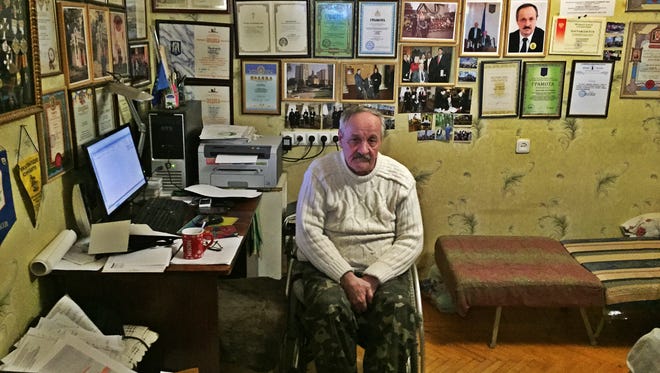
KIEV, Ukraine —Sergey Krasilnikov, 65, was 1 of about 800,000 soldiers, firefighters, engineers, miners, farmers and volunteers tasked with taking office in the Chernobyl cleanup operation subsequently the accident. They were known as "liquidators." Well-nigh were between the ages of 18 and 22 and came from the iii worst-afflicted countries: Belarus, Russia and Ukraine, all then part of the Soviet Marriage. They were exposed to various radiation levels, and 20% may take died by 2005 while in their 30s and 40s, according to the Chernobyl Foundation, which raises funds for Chernobyl-related projects. It is not known how many are still alive, but more than ninety% of the liquidators had radiation-induced wellness bug, such as thyroid cancer, middle disease and respiratory and digestive issues, although many scientists say not all these health problems can be attributed to radiation.
Krasilnikov had a stroke in 1994, leaving him paralyzed on the left side of his trunk and needing a wheelchair. He lives in a cramped, two-room apartment on the fifth floor of a building with no elevator or lights in the hallway on the outskirts of Kiev. He lives there with his wife, Nataliya, and two cats, Zeus and Julia Volodymyoiune.
Hanging on the walls are about two dozen framed medals and photographs of Krasilnikov with dignitaries and at diverse ceremonies. In some he is in the wheelchair, others not. One motion-picture show shows him in his wheelchair and dressed in accommodate and tie, on the roof of an abandoned building inside the Chernobyl Exclusion Zone, the closed expanse effectually the nuclear plant. A few years ago, he went on a hunger strike for 53 days to protest what he says is a lack of support from the government for people like him. He runs a group that raises coin for invalid liquidators in his local expanse. Information technology has 1,586 members.
Here are his words, edited and condensed for clarity:
Earlier Chernobyl, liquidation always meant to pause something, to eliminate, to destroy. Afterwards the accident, the word received a new life and pregnant. A liquidator became a person who rescued people and living things. A person who creates. We were proud of this, and put our souls into the work.
But at present it'south clear to me that we belonged to a generation that was thrown away. We were brought up in the spirit that you lot needed to requite your life for your country, and that the outset matter you should think almost is the motherland. Nosotros all had smashing zeal to exercise something to overcome this disaster. When information technology happened, in that location was a great rush to get help. Nobody realized the furnishings of radiations because it has no smell. It is invisible. People did not have any protection.
Chernobyl: Timeline of a nuclear nightmare
Over time, we went from being heroes to outcasts. I tin can tell yous, we never thought that giving up our own health and protecting the Ukrainian people would eventually lead to u.s. becoming irrelevant both to the state and to the people. That one solar day no ane would take any interest in united states of america.

My job was to assist organize the evacuation of the city of Pripyat. Information technology started on the twenty-four hour period afterwards the disaster at two p.m. The buses were coming from all over Ukraine, and I had to tell them where to go. There were about 1,200 to 1,500 buses, plus the same number of trucks and military vehicles. It was a lot. I remember that when I arrived in Pripyat, a few select units of the war machine were dressed in special protective suits and had respirators. At the aforementioned time, local people were just in their ordinary dress. I call up it was a very hot twenty-four hour period. 'Shut off your h2o and gas. Please close the windows. This is a temporary evacuation.' This was appear repeatedly, at one-minute intervals, over a loudspeaker.
People were in a panic, and virtually of them were women and children. I think people realized they were never going to come dorsum home again to Pripyat so they tried to take as many things with them as they could carry — toys and bedsheets and everything imaginable — but a lot of it was confiscated at the checkpoints. They were evacuated to nearby cities and towns. There was absolute confusion.
Nosotros were working every bit part of the emergency response so we had portable radios. We knew what was happening correct away. Everyone was communicating on open channels. Helicopters were circling the surface area constantly. At that place were rumors the explosion had acquired evacuations within a radius of 310 miles of Chernobyl. I thought to myself: Kiev is merely 43½ miles away. It felt like a funeral. Women were crying and hugging their children. It's incommunicable to describe.

I returned to Pripyat about a year after the ending to help build a wire argue around the city. It was a completely dissimilar atmosphere. The authorities were fussy, just it was calmer. The fence has since been dismantled. Subsequently, I was asked to help with the reconstruction of the power plant at Chernobyl. I worked every bit a foreman. Then in 1994, I got sick. After my medical cess they said my stroke and paralysis were a direct result of my work equally a liquidator. 'The loss of health is 100%,' the doctor said. Nonetheless information technology still took a long time before I got any inability assistance from the regime, and we lived manus-to-mouth and had to sell a lot things. And exercise you know what they gave me for all this health damage in the end? Enough to buy about 700 grams of butter (virtually 1½ pounds).That's how the state appraised the harm to my health from Chernobyl. They gave me a pension eventually. I now go nearly 5,000 Ukrainian hryvnia ($200) a calendar month. Of this, I pay 3,500 (about $136) each month to the hospital for treatment.

Allow me tell you: In 1986, I was 35 and was studying at the Kiev Institute of Civil Applied science. I imagined my future would expect different to how it is at present. The occupation of a builder was respected. I was expecting to piece of work in the edifice industry in Kiev. For the last 30 years, I accept had to bury a lot of the members of our community. We are always trying to raise coin for serious and expensive surgeries. I know what the mental attitude of the state is: They don't intendance, because they don't need u.s. whatsoever longer.
A condom dose of radiations? Opinions vary wildly
Had I known with what indifference and scorn the country would treat me now, I may not accept agreed to be a liquidator. Still, knowing what I know now, I would probably human action in a similar way. I had family in Kiev. I wasn't saving country bureaucrats, I was saving the ordinary people of this country. I was protecting the people of Ukraine from the spreading of nuclear toxicant. In this style, I congenital the church in miniature. I wish I had lived a different life, simply I would not live the 1 I was given differently.

Source: https://www.usatoday.com/story/news/world/2016/04/17/liquidator-chernobyl-30th-anniversary/82895730/
Posted by: stephensarly1995.blogspot.com
0 Response to "What Happened To The 3828 Men That Cleaned The Roof At Chernoable"
Post a Comment